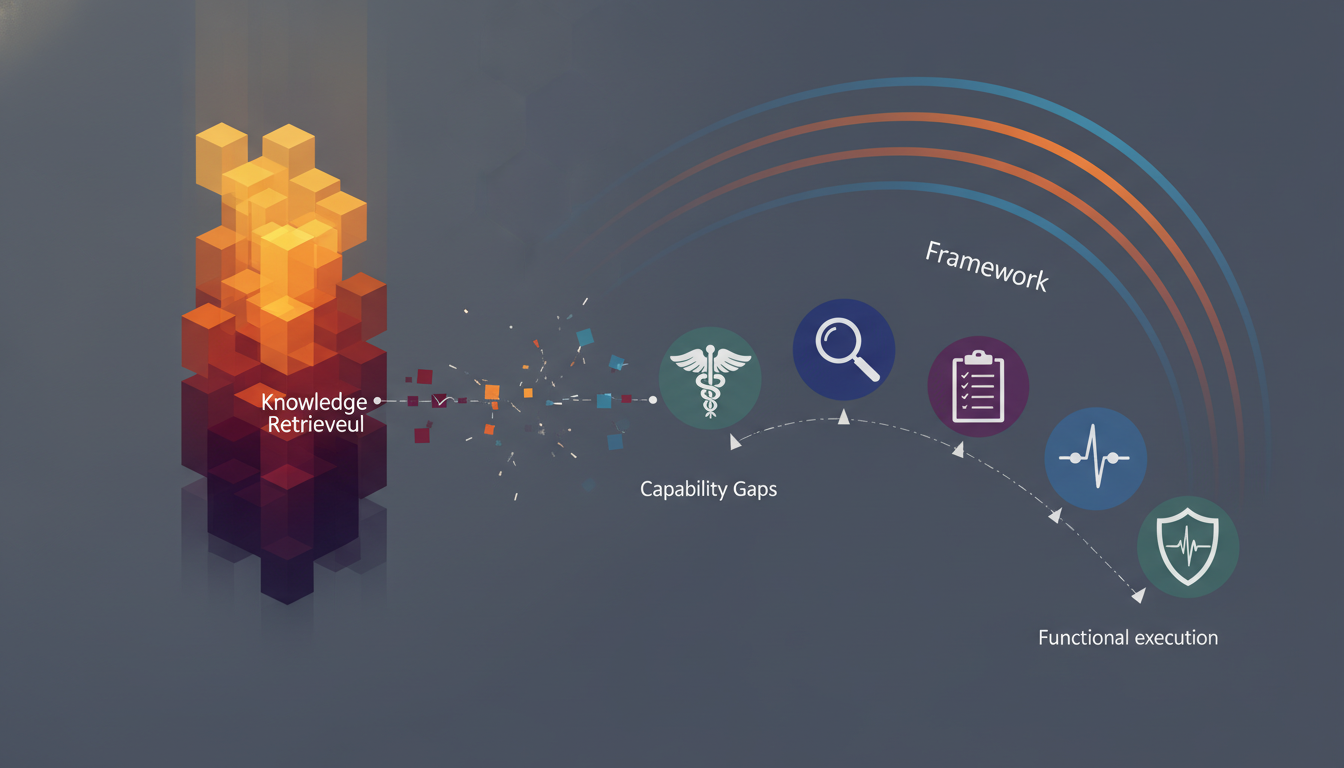
According to arxiv.org, researchers have introduced MEDIC, a comprehensive evaluation framework designed to assess large language models (LLMs) for clinical applications across five dimensions. The framework addresses a growing disconnect between theoretical capability and verified utility in medical settings.
While LLMs achieve “superhuman performance on standardized medical licensing exams,” according to the research paper, these static benchmarks have become “saturated and increasingly disconnected from the functional requirements of clinical workflows.” The MEDIC framework establishes “leading indicators of clinical LLM competence” that reveal capability gaps before costly deployment-based evaluation.
According to arxiv.org, the framework goes beyond standard question-answering by assessing operational capabilities using “deterministic execution protocols” and a novel Cross-Examination Framework (CEF). The CEF “quantifies information fidelity and hallucination rates without reliance on reference texts,” according to the paper.
The evaluation exposes “critical performance trade-offs” and reveals a key divergence “between static knowledge retrieval and functional execution,” according to the authors. The research team includes Praveenkumar Kanithi, Clément Christophe, Marco AF Pimentel, and several other researchers, according to arxiv.org. The framework aims to inform model selection for clinical workflows by identifying these upfront indicators of competence.