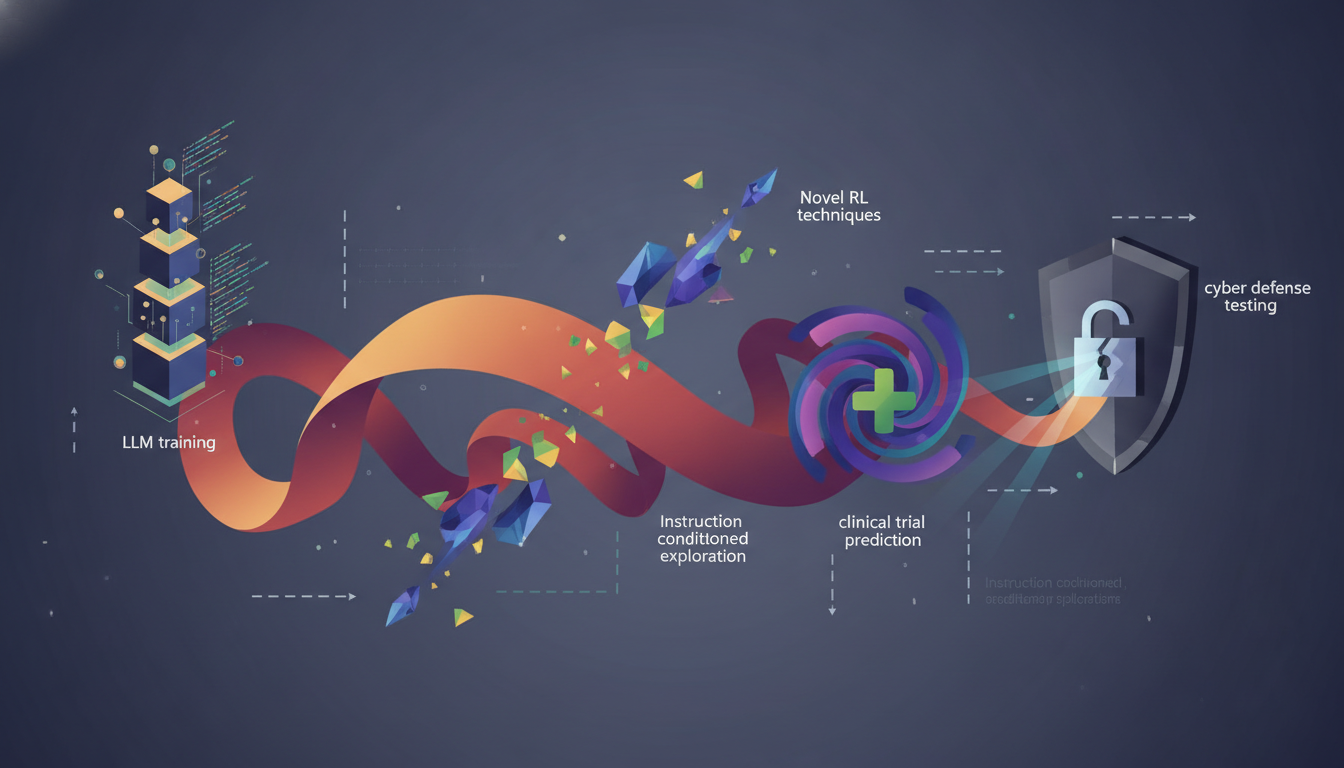
Researchers have introduced several new reinforcement learning (RL) approaches for training and testing large language models across diverse applications.
According to arxiv.org, a method called Instruction-Conditioned Exploration (ICE) combines RL with self-distillation to improve LLM performance on mathematical reasoning tasks. The technique appends “one of a small fixed set of instructions to task prompts during training” and distills correct responses into an unconditioned policy. ICE improved Qwen3-1.7B pass@1 performance by 5.0% relative to training with DAPO at 4K response length, with improvements persisting at 8K context, though the gains “do not appear for Qwen3-4B at 4K.”
In clinical research, DeepImagine uses stepwise counterfactual reasoning to predict trial outcomes, according to arxiv.org. The framework starts from a historical trial and “sequentially modifies one differing experimental factor at a time,” with an LLM evaluating how each change would affect outcomes. DeepImagine “consistently outperforms direct one-step prediction across several off-the-shelf LLMs.”
For cybersecurity, Trident introduces an agentic framework for testing Deep RL cyber defenses, according to arxiv.org. The system includes benchmarks spanning CybORG CAGE 4 and CyberWheel, over 13,000 interaction trajectories, and a “Code-as-Policy” architecture. Trident reduced blue agent defensive performance by an average of 522% compared to static baselines while discovering emergent behaviors like “decoy avoidance and adaptive state prioritization.”
A fourth paper proposes Observation-Calibrated Self-Distillation (OCSD), which addresses confounding issues in on-policy self-distillation by contrasting replay views to derive “an observation residual,” according to arxiv.org.