Researchers have published four papers addressing distinct challenges in AI systems, from conversational memory to hardware acceleration.
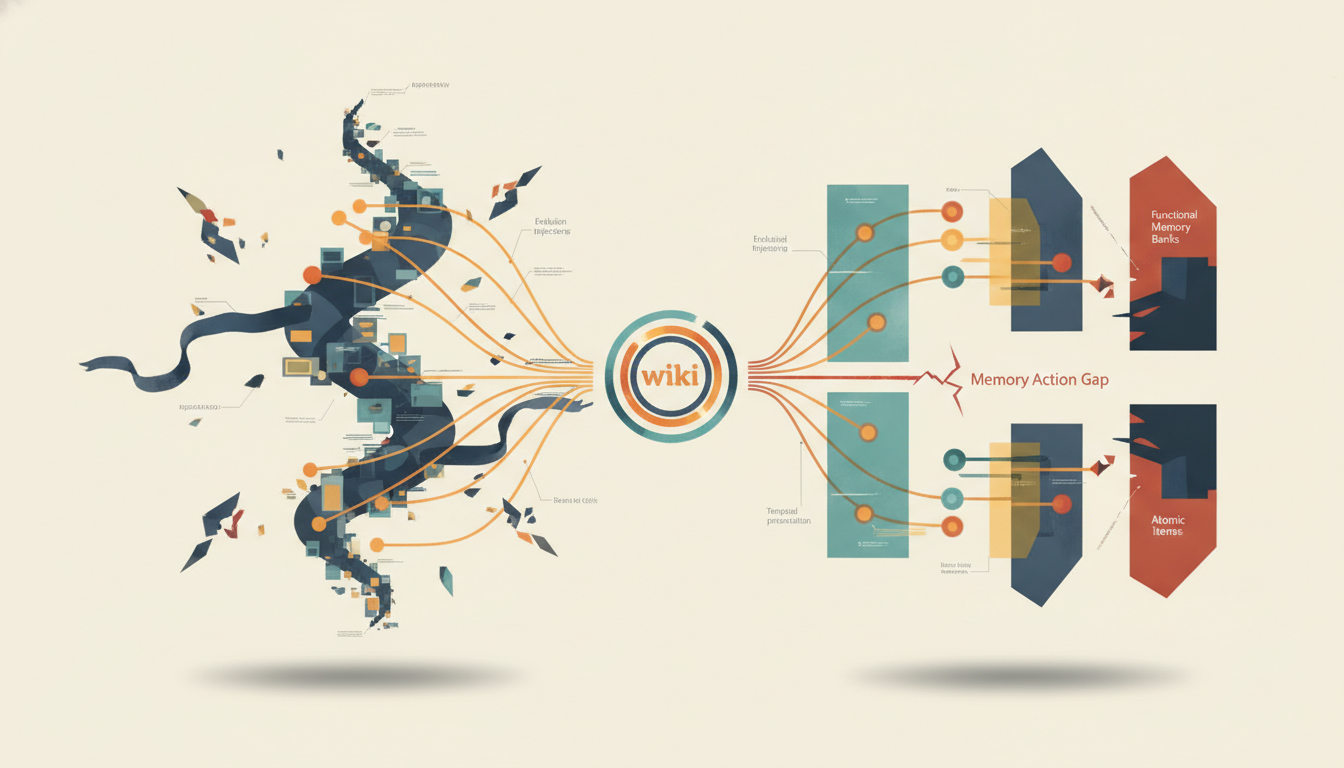
According to arxiv.org, TrajWiki introduces a trajectory-based memory framework for long-horizon conversational agents. The system represents each memory as a “source-grounded evolution trajectory” maintained through immutable episodic snapshots and claim-level operations including ADD, REVISE, and DEPRECATE. The framework includes a “Memory Wiki” layer designed to reduce fragmentation and retrieval costs.
A separate paper on arxiv.org presents MemArbiter, which addresses what researchers call the “Memory-Action Gap” in LLM agents. The system organizes interaction histories into atomic items across five functional Memory Banks, combining “bank-level demand, item-level relevance, focal-ambient representations, and a temporal presentation gate” to control memory salience. According to the research, MemArbiter achieved success rates of 82.8% and 92.5% under 500- and 750-token budgets in ALFWorld tests, outperforming the strongest baseline by 20.9 and 25.4 percentage points respectively.
On the hardware front, arxiv.org reports that ThAME proposes a 3D heterogeneous multi-chiplet architecture for Mixture of Experts (MoE) inference, achieving speedups of up to 15.7x and energy efficiency improvements of up to 9.8x over state-of-the-art counterparts.
Finally, TRACE-TS, described on arxiv.org, introduces attribution-grounded reasoning for wearable sensor data, achieving 84.43% accuracy and 81.24% F1 scores across seven benchmarks.