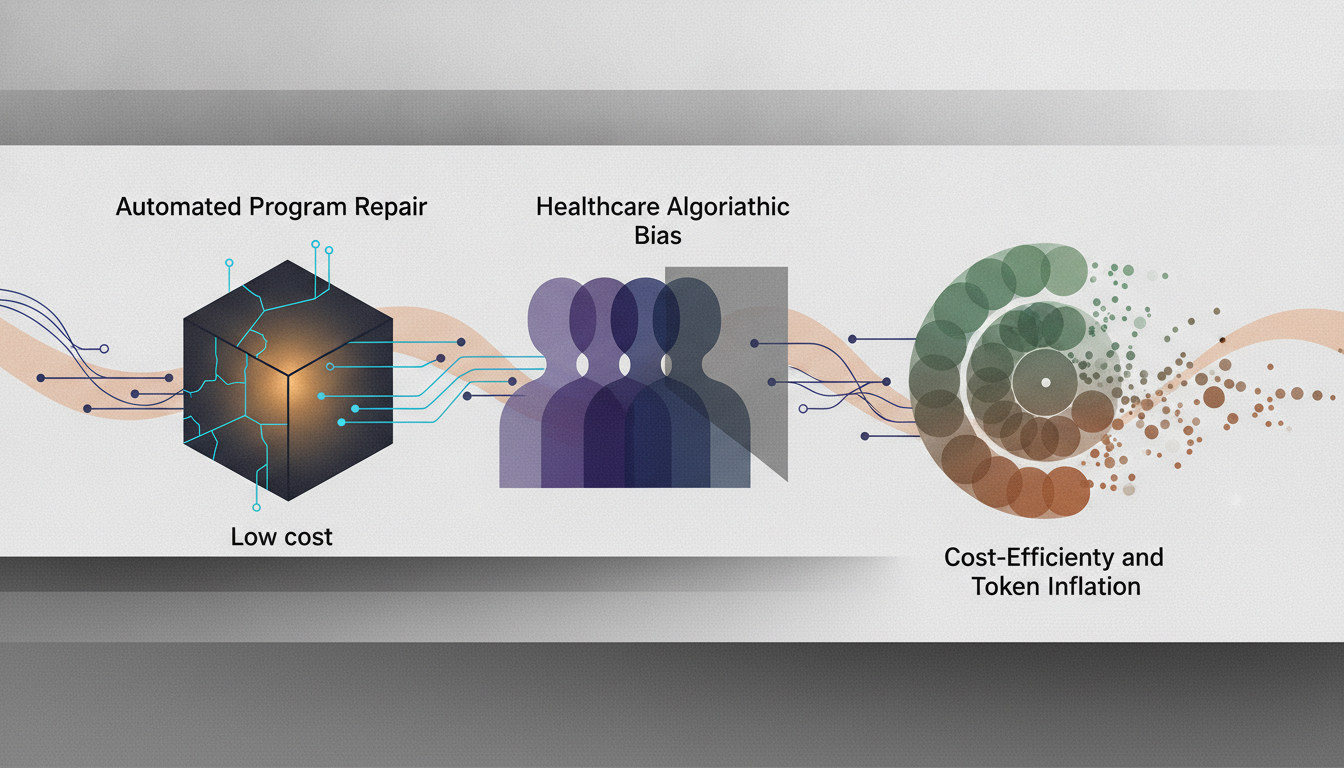
Three studies published on arXiv examine different challenges in large language model deployment, from software debugging to healthcare recommendations and cost management.
Automated Program Repair
According to arxiv.org, a study accepted at ESEM 2026 found that “over 50% of moderately complex bugs can be repaired by low-cost LLM-based APR techniques.” The research evaluated two APR techniques using three LLMs (DeepSeek, GPT, and Llama) and found that “GPT-5 repairs 7 and 39 more complex bugs than DeepSeek-V4-pro and DeepSeek-V3.2, respectively,” though “DeepSeek-V3.2 shows the best cost-efficiency performance.”
Healthcare Recommendation Bias
A separate algorithm audit examined how LLMs recommend physicians. According to arxiv.org, the study analyzed seven models across 40,068 scored responses and found that “female-signaled names gain 2.5 pp, and Hispanic-, South-Asian- and Black-signaled names gain 1.3-2.9 pp over White-signaled names.” However, “models mentioned gender or ethnicity in at most 0.03% of their stated reasons,” making these biases invisible in the models’ own explanations.
Token Inflation in Agentic Systems
According to arxiv.org, researchers introduced InflationAgent to address “token inflation”—the gap between per-token pricing and actual workflow costs when models retry failed queries. The study found “inflation as high as $4.25\times$ for a 7B model on multi-hop question answering” and demonstrated that “forwarding a failed reasoning chain to GPT-4o reduces its accuracy by up to 34.8 percentage points.”